
Might is not power: what the midterms say about technology
The 2026 midterms have just buried the myth of the entrepreneur as saviour. Behind the results lies a question deeper than a change of majority, namely what technological might can buy, and what it cannot.
The Trump era opened on a rallying myth: that the great tech bosses, masters of optimisation and captains of industry, were the last people capable of fixing a stalled United States and restoring its standing. That promise helped Trump win in 2024 with a more diverse coalition than in 2020. He took 48% of Hispanic voters, up from 36% four years earlier, and 40% of Asian American voters, up from 30% [1].
Midterms often punish the party in power, and Trump's was no exception. This time, though, voters did more than pass judgement on a record. Their ballots also defeated several attempts to turn the financial might of technology players into political support. It would be going too far to read this as a rejection of technology itself. But the results do call into question the claim of some of its biggest beneficiaries to speak for the majority.
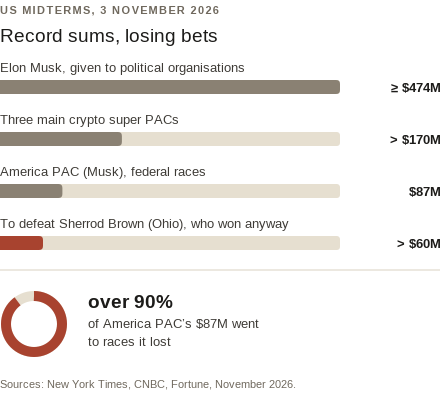
The signal is neither minor nor subliminal. It matches the scale of the tech bosses' unprecedented mobilisation behind the president. Crypto money did not follow a single party line, however: some thirty million dollars also went to Democratic candidates [2]. By 3 November, the three main crypto super PACs (Fairshake, Defend American Jobs and Protect Progress) had reported more than $170 million in spending [2], while Elon Musk had given at least $474 million to political organisations, according to a New York Times tally [3][4]. Yet the most visible bets failed. In Ohio, more than $60 million spent to defeat Democrat Sherrod Brown, by backing Republican incumbent Jon Husted or by attacking Brown directly, did not stop him from winning [2]. In Texas, the Republican candidates Musk backed for the Senate and for governor were both defeated [4]. At federal level, more than 90% of the roughly $87 million spent by his America PAC went to races it lost [4].
So behind these results lies a question deeper than a change of majority: what technological might can buy, and what it cannot.
It is tempting to read these record sums as an attempt by the tech industry to seize power. That reading is incomplete. Those who funded these campaigns already wield considerable might. Crypto has made its fortune, Musk dominates commercial spaceflight, and the AI giants are building the infrastructure of the century. Their technology has already given them economic, industrial and material leverage.
What they were trying to buy was therefore not a conquest but a defence: keeping in place the political and regulatory conditions that allow that might to last.
What technological might cannot buy
Might is a capacity: technical, financial, energetic. It can be owned, accumulated and measured.
Power is a political relationship: the ability to decide, to set rules, to be obeyed or to have one's authority recognised. It can rest on wealth and technology, but it is not the same thing.
I define a technology as a complex system that transforms energy through the industrialisation of one or more techniques on formal and/or scientific foundations, in order to create and/or modify power relations within our societies. Those power relations never amount, on their own, to legitimacy.
A successful technology generates enough might to tip the balance between competing forces. Paradoxically, that might does not operate in a vacuum. It depends on conditions that are not entirely in the hands of those who hold it: a rule that permits it, available energy, land to build on, infrastructure to connect to. These conditions are negotiated or decided by political institutions at every level, federal, state and local.
Money is a form of might. The vote is one of the ways a society grants or withdraws political legitimacy, and with it a mandate to exercise power. The 2026 elections expose the gap between the two. They also show where the fight over technology is really taking place: in the space between might, power and legitimacy.
Texas, where solutionism went to die
Texas is where the meaning of 3 November is clearest.
The state has become the rear base of American tech. Tesla built its largest US plant there, SpaceX runs its launch operations there, and for years Texas sold itself as a haven for entrepreneurs fleeing California and its regulations. No Democrat had won a statewide race there since 1994 [5].
Texas had made itself the showcase of technological solutionism, a term popularised by Evgeny Morozov to describe the belief that political and social problems are, at bottom, technical problems that a sufficiently capable engineer or entrepreneur could solve [6].
James Talarico won the Senate race, ending three decades of Republican victories [5]. Gina Hinojosa, for her part, beat Greg Abbott in the race for governor [4]. These results were part of a broader Democratic wave, and cannot be read as a referendum on Elon Musk or on technology alone.
Still, the fact that Musk's candidates lost precisely there, in the state that had offered itself as the laboratory of that promise, makes it a signal in its own right. Solutionism was beaten there neither by a rival technology nor by another billionaire, but by voters who refused to hand the state's government to the candidates of the people who own its factories. This is where the promise suffered its most spectacular political setback. In the state that had celebrated it most, economic clout and industrial investment were not enough to win over the voters.
The end of the saviour-entrepreneur myth
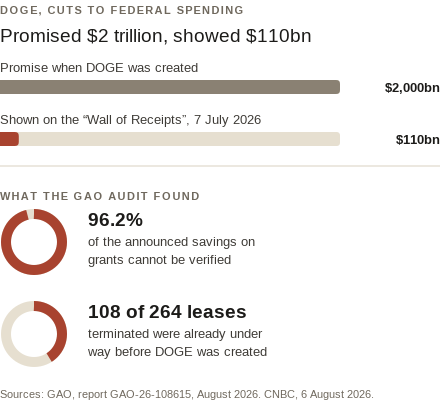
Beyond solutionism, it is the myth of the entrepreneur as the nation's saviour that is collapsing. The protest vote was aimed first at Trump, a businessman who had turned his private success into a political argument. But the myth took its hardest blow from DOGE, the department entrusted to Elon Musk. The tech bros' thesis was simple: a state can be run like a start-up, and the methods that built Tesla and SpaceX could save an administration deemed bloated. The Department of Government Efficiency promised to cut federal spending by $2 trillion [7].
The results are far less spectacular. The Government Accountability Office, the independent body that audits federal accounts and programmes, examined the savings DOGE claimed. As of 7 July 2026, DOGE's "Wall of Receipts" displayed $110.34 billion in announced savings on contracts, grants and leases. But the calculation method was too poorly documented to verify a large share of those amounts [8].
Among other findings, the audit noted that the 264 leases presented as terminated were worth only $53.5 million according to the itemised figures, against the $113 million claimed by DOGE. After review, the GAO put the identifiable savings at just $31.8 million. On top of that, 108 of those leases, worth $15.3 million, were already being terminated before DOGE was created. For grants, 96.2% of the announced savings could not be verified by the GAO [8][9].
Not all of these savings were fictitious. But without a transparent method, nobody can say which ones are real. What the audit calls into question is the claim that a state can be transformed by the advertised efficiency of a company alone.
The amounts DOGE later claimed never came close to the initial promise of $2 trillion. And even those turned out, in large part, to be impossible to verify. The entrepreneur's method ran into a reality that start-up rhetoric tended to erase. A state is also made of rights and checks and balances, which cannot be streamlined like an org chart.
Data centres, a battlefield on two fronts
The move from might to power plays out less in the big electoral races than on more concrete ground: data centres.
A data centre is digital infrastructure, but it is also an industrial facility. It turns vast amounts of electricity into computing capacity. Platforms, social networks, the cloud, streaming and generative AI all depend, to varying degrees, on these buildings full of servers.
Whoever owns this infrastructure controls part of the material means on which everyone else depends. But that position comes at a price. Building and running a data centre takes land, water, electricity, grid connections and permits. This is where technological might meets political power.
The technological battle
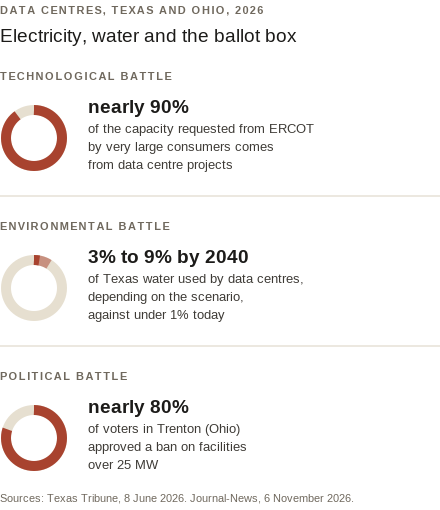
The AI race has changed the scale of demand. In Texas, the grid operator ERCOT has received hundreds of connection requests from very large consumers. Together they add up to several hundred thousand megawatts of potential load, nearly 90% of it tied to data centre projects [10].
ERCOT does not expect all of these projects to materialise. The requests nonetheless show how hungry the companies are. Texas also has hundreds of data centre projects announced or planned [10].
Permitting these buildings therefore helps decide where the next layer of digital infrastructure will be built, and who will control its capacity. The leverage the companies have acquired can extend into concrete, power lines and servers. But it can also run up against a local decision or the limits of the grid.
The political and environmental battle
Each of these buildings draws on shared resources. Electricity, first. Connecting large new consumers can require investment in the grid, and who pays for it becomes a political question. Households and businesses do not necessarily want to bear the consequences of infrastructure built to meet the needs of a handful of industrial players.
Water, next. According to projections cited by The Texas Tribune, data centres, which today use less than 1% of the state's water, could account for between 3% and 9% by 2040, depending on the scenario [10]. Add to that the tax breaks granted to some projects, which raise the question of how private gains and public costs are shared.
This is where the environmental question becomes a question of power. Who decides how a power grid, an aquifer or a plot of land is used? The residents who depend on them, the officials who represent them, or the companies that need these resources to grow?
On 3 November, the question went all the way to the ballot box. According to Ballotpedia's count, 41 local measures on data centres were put to voters in ten states. The results overwhelmingly favoured restricting or opposing projects, with a single measure bucking the trend [11]. The measures varied from one town to the next: some sought to limit facilities, others to make them easier to build.
In Trenton, Ohio, a ban on facilities over 25 megawatts was approved by nearly 80% of voters. It could block an eighteen-building Amazon Web Services project, if the land in question is annexed by the city [12]. In Emporia, Kansas, voters also approved a ban on so-called "high-impact" facilities [13]. In Monterey Park, California, a ban was passed as well [13].
In Ohio, Sherrod Brown campaigned against his opponent's support for data centres. In Texas, Gina Hinojosa called for a moratorium on new projects, the removal of certain tax breaks and the principle that developers should cover the full electricity costs of their facilities [4]. According to a CNBC poll, a majority of voters surveyed considered data centres an important or decisive issue in their choice [11].
These results show that people intend to have a say in decisions that affect their land, their resources and their bills.
Where the two battles meet
The two battles are really one. To extend its might, technology needs energy, water and land. To get them, it needs permits. And those permits are in the hands of political institutions, sometimes very local ones.
A platform can dominate a global market and still depend on a town council for its next building.
A small town in Ohio has neither Amazon's capital nor its infrastructure. Yet it holds a political lever: the ability to decide, within the limits of its authority, what can be built on its land.
This is a concrete limit on technological might. Residents are not richer than the companies. But economic might is not enough to abolish collective rules. Influence, however massive, does not exempt anyone from obtaining permission.
You can bankroll the world without governing it.
Fixing, not ruling: a demand for hands-on government
The tech giants have not lost their influence, and the Democrats have not been handed a blank cheque.
What voters are asking for is real effectiveness: local pragmatism and practical competence in the very exercise of political power, the opposite of technological spectacle.
The alternative to solutionism is to bring technology into public action differently, to make politics more accessible and more accountable, without claiming to replace it.
Zohran Mamdani, mayor of New York since January, offers one example. Far from Silicon Valley's messianic rhetoric, grassroots officials are using social media to answer citizens directly. In New York, residents film a pothole and call out the mayor on TikTok. The hole is sometimes filled the same day, and the video of the repair goes round in turn [15]. On substance, the programme comes down to tangible measures: a rent freeze on about a million rent-stabilised apartments, voted in June [16], and free buses, promised but still awaiting funding from New York State [17]. Here technology finds its proper place: a system whose power relations are redirected towards citizens, serving a close-to-the-ground presence and the repair of everyday damage.
This other way of doing politics takes more than effective tools. It means rebuilding a relationship of trust and a capacity for collective action that capital alone cannot produce.
The tech bros wield considerable might. What they lack is something no amount of capital provides: the power to make their choices accepted by the people who will live with the consequences.
In 1377, Ibn Khaldūn completed the Muqaddimah [14]. In it, he asks why dynasties rise, flourish and then collapse. His answer comes down to one word: asabiyya, group cohesion, the sense of belonging that allows a social body to act as one. Money can buy support. It cannot manufacture asabiyya.
The Muqaddimah does not explain the midterms, but the analogy raises a question: can a coalition of interests bankrolled by capital produce the collective cohesion that lasting power requires?
That is the main lesson of these midterms. Confusing what one can do by virtue of one's might with what one has a legitimate right to do in the name of the majority is a major political mistake.
Sources
- Pew Research Center, "Behind Trump's 2024 Victory, a More Racially and Ethnically Diverse Voter Coalition", 26 June 2025, based on a panel of voters whose turnout was verified against voter files.
- Fortune, "Crypto PACs spent $170 million on the midterms—and came up nearly dry", 4 November 2026. Spending by crypto PACs, results in Ohio and the split of support between Republican and Democratic candidates.
- The Next Web, "Musk's midterm donations hit a record $474M, The New York Times reports", 2 November 2026, based on a New York Times tally drawing on FEC and IRS filings and state records.
- CNBC, "Elon Musk suffers political setback in 2026 midterms", 4 November 2026. Political spending by Musk and America PAC, results in Texas and candidates' positions on data centres.
- Time, "Talarico wins Texas Senate race, first Democrat to win statewide in more than 30 years", 4 November 2026.
- Evgeny Morozov, To Save Everything, Click Here: The Folly of Technological Solutionism, PublicAffairs, 2013.
- CNBC, "GAO finds Elon Musk's DOGE inflated claims of $110 billion in savings for federal government", 6 August 2026.
- Government Accountability Office, DOGE Wall of Receipts: More Transparency Needed on How Savings Are Derived, GAO-26-108615, August 2026.
- Government Executive, "DOGE took credit for savings that never happened, watchdog finds", August 2026.
- The Texas Tribune, "An unprecedented data center boom means new challenges for Texas. Find out what's planned near you.", 8 June 2026. Announced projects, connection requests to ERCOT, water use (based on a University of Texas at Austin white paper) and the stakes for the power grid.
- CNBC, "Voters rebuff data centers in every ballot measure except one during the 2026 midterms", 4 November 2026, based on Ballotpedia.
- Journal-News, "Trenton data center ban passes with nearly 80% of the vote", 6 November 2026.
- Route Fifty, "Voters reject data centers in local ballot initiatives", 4 November 2026.
- Ibn Khaldūn, Al-Muqaddimah, 1377. English translation by Franz Rosenthal, The Muqaddimah: An Introduction to History, Princeton University Press, 1958.
- Revolt, "Zohran Mamdani pothole repairs go viral on TikTok", August 2026. See also CNN, "Mamdani is responding to NYC complaints made on social media", 11 August 2026.
- Bloomberg, via Insurance Journal, "Mamdani Delivers Rent Freeze in Milestone for New York City Tenants", 26 June 2026.
- The National Desk, "New York City Mayor Mamdani says his plan for free buses won't happen in 2026", 8 April 2026, based on an interview with Politico.