
Why are young people taking to the streets?
Blockaded schools in France, governments toppled in Nepal and Madagascar. The local grievances differ, the underlying drivers are the same: a present with no prospects, a future that frightens, a deep distrust of politics. And in the middle of it all, digital tools that have become the battleground for control of the narrative.
On 6 October, hundreds of thousands of people marched across France in a movement that started in the country's secondary schools. A year earlier, Gen Z had brought down the governments of Nepal and Madagascar.
In 1970, the Brazilian archbishop Hélder Câmara described a spiral of violence. At its base lies an established violence: the injustices inflicted every day, quietly. Then comes revolt, in response. Then repression, which answers the revolt and sets the spiral turning again [24].
There is no single violence, only violences. The World Health Organization defines violence as "the intentional use of physical force or power, threatened or actual, […] that either results in or has a high likelihood of resulting in injury, death, psychological harm, maldevelopment, or deprivation" [25]. Power, deprivation: the definition takes in forms of violence that leave no bruises.
It follows that violence cannot be answered without understanding its causes. That is the WHO's own approach: no single factor explains violence, which has to be analysed at the level of the individual, of relationships, of the community and of society [25]. Answering with force alone means entering what game theory calls a negative-sum game: whatever one side wins never makes up for what the other loses. Filing these protests under the eternal anger of youth is a sure way never to find the exit.
To understand what lies behind this anger, look away from the television studios and at what statistics offices and researchers have been measuring for years.
Three drivers come up everywhere: a present with no prospects, a future that frightens, a deep distrust of politics. The fourth element is not a cause but an amplifier: technology.
Fifteen years on
I lived through the Arab Spring and the Occupy movement from the inside. I marched, I organised, and I heard the same arguments: either we were being manipulated by political agendas, or we were traitors to the nation, or we were nihilists, and for some people we were all three at once…
And yet, in Morocco for instance, the latest parliamentary elections have largely proved the generation that took to the streets right.
So it is with a strange sense of déjà vu that I watch what is happening today: young faces, a rallying cry that travels faster than any official statement, coordination through tools that nobody in power really controls, violence breaking out, and a power struggle that every government, whatever the country, tries to win through force and fear.
In France, the movement started in the lycées, the upper secondary schools. On 6 October, the Interior Ministry counted 256,000 protesters, 56,000 of them in Paris. The organisers claimed 450,000. The Education Ministry reported 891 schools disrupted, for all reasons combined, and the day ended with 488 arrests [1]. The demands are concrete: crumbling buildings, overcrowded classes, absent teachers who are never replaced, police violence. On 17 October, the students joined a protest against the cost of living called by members of the gilets jaunes (the yellow vests, the 2018 cost-of-living revolt) and backed by trade unions including the CGT and Solidaires [23].
The demands are French. The drivers behind them can be found from Kathmandu to Lima.
"'Youth' is just a word," said Pierre Bourdieu [16]. It is split along lines of education, geography, gender and politics. Some young people do not protest at all, and others vote for the exact opposite of what the marchers want. The figures that follow describe a condition shared by a generation, not a unanimous opinion.
Which raises the question: are these young people's demands legitimate, or are they just lazy kids?
First driver: a present with no prospects
The first engine of anger is the most concrete: jobs. In the second quarter of 2026, unemployment among 15 to 24-year-olds in France reached 21.6%, against 8.3% for the workforce as a whole [2]. It rose 2.5 points in a year, three and a half times faster than for the whole workforce (+0.7 points). Over the same period, the share of 15 to 24-year-olds in work fell by a point, to 33.8%. In the second quarter, around 740,000 people aged 15 to 24 were unemployed under the International Labour Organization definition, meaning out of work and actively looking. Those not looking are not counted [2].
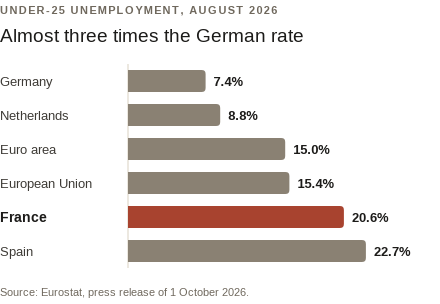
The youth rate measures unemployed 15 to 24-year-olds against the active population of that age group only, leaving students out. It is therefore structurally higher than the overall rate. Yet the gap with Germany or the Netherlands, where the rate is two to three times lower, shows that this is not a European inevitability [3]. Eurostat's figure for France (20.6% in August) differs from that of Insee, France's national statistics office (21.6% in the second quarter): they are two separate series covering two different periods.
Housing adds to this. In the big cities, it has become a filter on the road to independence. The sequence of "degree, then job, then a place of your own" that underpinned the unwritten contract of earlier generations no longer holds within the expected time.
Second driver: a future that frightens
The second driver barely shows in employment statistics, but it dominates the surveys: the future no longer promises anything better than the present. In an Ipsos BVA survey of 3,030 people aged 18 to 29, published in early October, more than eight in ten fear a harder life than their parents had, 84% think finding a stable job will be harder for them than for the previous generation, and nearly eight in ten have considered building their life elsewhere, a third of them seriously [4]. The implicit promise made to every generation, that it would do at least as well as the one before, has broken.
The climate adds a physical horizon to this sense of downward mobility. The reference study remains the one by Caroline Hickman, Elizabeth Marks and their co-authors, published in The Lancet Planetary Health in 2021 and based on 10,000 people aged 16 to 25 in ten countries [5].
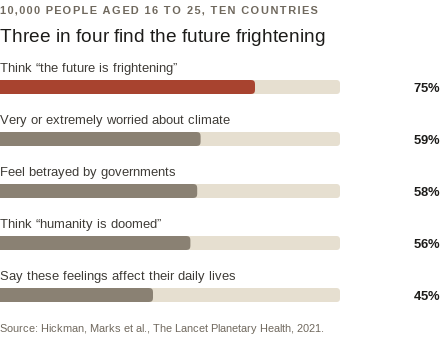
The ten countries are in very different situations, which limits how far the findings can be generalised. The scale, though, is beyond doubt. When three young people in four say the future frightens them, their worry is hard to dismiss as a generational whim. That does not mean they all share the same diagnosis, or that this anxiety leads to the streets. It can just as well lead to withdrawal, or to emigration.
Nor is the climate the main demand of any of the movements discussed here. What these young people are asking for is schools, hospitals, water and leaders who answer for their actions. Climate anxiety does not bring people onto the streets. It closes off a horizon that the economy has already narrowed.
Third driver: distrust of politics
The third driver is political. Since 2009, the political trust barometer of CEVIPOF, Sciences Po's political research centre, has tracked the erosion of trust in parties, Parliament and government. In the wave published in February 2026, distrust and weariness dominated the mood of 45% of French people, enthusiasm that of 7% [6].
Among the young, the distrust takes a specific form: they do not feel represented [4].
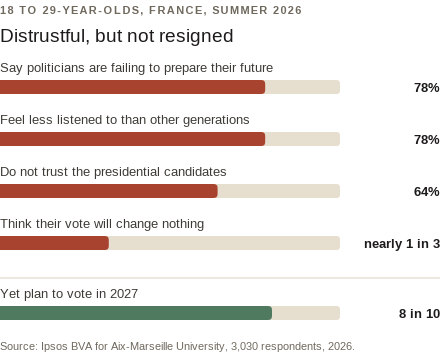
The last line is the one that best explains this generation, treated as children when the aim is to claim they are being manipulated, and demonised when the aim is to justify brutality against them. The survey does not say who they will vote for, and they will not all vote the same way. But this generation is not rejecting politics. It is rejecting institutions in which it no longer sees itself, and no amount of brutality will change that.
Morocco shows what happens when that gap is not closed. In autumn 2025, the GenZ 212 collective demanded health and education before stadiums for the World Cup. A year later, the parliamentary elections of 23 September 2026 drew a 38% turnout, the lowest since 2007 [14]. The Moroccan news site Le360 measured voters against the roughly 26.7 million Moroccans of voting age, rather than against the 15.8 million registered voters: on that basis the figure falls to about 22.5% [15]. And 18 to 24-year-olds make up barely 4% of registered voters [15]. The calendar steepened the fall: in 2021, the parliamentary elections were held on the same day as local and regional elections, which had pushed turnout above 50%. Nothing proves that the abstainers were the protesters, or that they share GenZ 212's demands. But the result is consistent with the collective's diagnosis: a generation that does not feel represented ends up not turning out.
One movement, many time zones
What has stood out since 2024 is the simultaneity: movements with no organised link between them have erupted within months of each other on several continents [7][8][18][19][20][21][22].
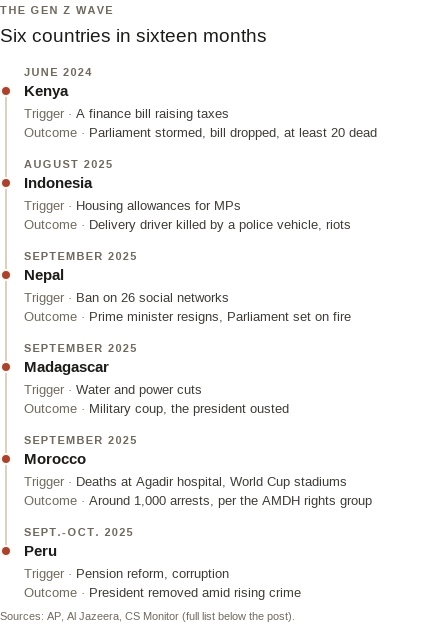
The local causes differ, but the grammar is shared: young people who are educated and underemployed, perceived corruption, leaderless movements, digital coordination. And a common symbol, the pirate flag from the manga One Piece, waved from Jakarta to Antananarivo [21].
These three drivers are the dry tinder, not the spark. Youth unemployment was already high in France ten years ago without schools being blockaded, and the sociology of social movements has said so since Charles Tilly: discontent alone does not set a crowd in motion [17]. It takes a trigger that makes the injustice visible and gives it a date: the social media ban in Kathmandu, deaths at the hospital in Agadir, run-down and overcrowded classrooms. It also takes organising to be cheap. That is where technology comes in.
Technology, an amplifier of power relations
I define a technology as a complex system that transforms energy through the industrialisation of one or more techniques on formal and/or scientific foundations, in order to create and/or modify power relations within our societies (I develop this definition in my Fresco of Technology). These movements illustrate it almost too perfectly.
Nepal shows it better than any other case. The trigger was not a tax but the infrastructure itself: the government blocked Facebook, YouTube, X and twenty-three other platforms. A few days later, it fell. On the Discord server where the movement was organising, a poll of a few thousand votes brought up the name of Sushila Karki. She was appointed interim prime minister on 12 September, after negotiations between the president, the army chief and representatives of the movement [20]. An online poll is not an election. Yet it was enough to impose a name, with no mandate whatsoever.
For those who mobilise, the tool lowers the cost of coordination. Zeynep Tufekci had already shown this from Tahrir Square and Gezi Park: a movement can now reach in a few days a size that once took months of organising [9]. She also shows the flip side. These movements skip the slow stages (meetings, settled disagreements, structures) that used to build the capacity to negotiate, to change tactics, to last. They rise fast and burn out fast. Nepal and Madagascar confirm it: the street brought down governments, but it did not choose what replaced them. In Madagascar, the army stepped in.
What decides the outcome, in fact, is neither numbers nor tools but the stance of those who hold the guns. In Madagascar, the turning point came when an elite army unit, CAPSAT, went over to the protesters [21]. In Nepal, the way out of the crisis was negotiated with the army chief [20]. In Kenya, the president withdrew his bill without power changing hands [18]. The sociology of social movements calls this the political opportunity structure: divisions among elites, the loyalty of the security forces, possible alliances. The same surge produces a withdrawn bill in Nairobi and a junta in Antananarivo.
For those who govern, the same networks serve surveillance, counter-propaganda and outright shutdown. Access Now's #KeepItOn coalition recorded at least 313 internet shutdowns in 52 countries in 2025, a record [10]. Not all of them target protests: armed conflicts account for four in ten. But all of them are a reminder of who holds the switch. Shoshana Zuboff has described how behavioural data becomes a resource for control [11]. A Discord server is not a public space. It is private infrastructure, which a company can shut down and an intelligence service can infiltrate. In cybersecurity, that is called a single point of failure.
The idea of pulling the plug comes back with every crisis, France included. In July 2023, after the riots that followed the death of Nahel, a 17-year-old shot by police during a traffic stop, Emmanuel Macron told a meeting of mayors that "when things get out of hand", it might be necessary to "regulate" or "cut off" social media [26]. The government backed away from the idea the next day. In May 2024, it did suspend TikTok in New Caledonia, the French Pacific territory, for two weeks during riots there. The Conseil d'État, France's highest administrative court, struck the decision down: a total shutdown is lawful only as a temporary measure, and only if no less drastic option exists [27].
Elsewhere, the experiment has been run. Some governments fell despite the shutdown: Mubarak's Egypt in 2011, Sri Lanka in 2022 [28], Bangladesh in 2024, where the prime minister fled the country on the very day of a new near-total shutdown [29], Nepal in 2025. Others held on: Iran in 2019, Belarus in 2020, Kazakhstan in 2022. But none held on because of the shutdown. In Iran, more than three quarters of the 304 deaths recorded by Amnesty International came in the 48 hours after the internet went dark [30]. In Kazakhstan, order was restored by troops from a Russian-led military alliance [31]. Where the shutdown "worked", it did not extinguish the anger. It hid the repression.
Research points the same way. Studying shutdowns imposed in Africa between 2017 and 2019, Jan Rydzak, Moses Karanja and Nicholas Opiyo find their effectiveness questionable at best, and observe that they are often followed by an escalation of protests already under way [32]. In India, Rydzak finds that shutdowns go hand in hand with a rise in violence far more than with peaceful mobilisation: deprived of the means to coordinate, protesters abandon the forms of action that demand the most coordination [33]. In Egypt, Navid Hassanpour showed that the shutdown of 28 January 2011 scattered the protests across Cairo instead of snuffing them out [34]. Pulling the plug solves none of what brought people onto the streets. It is one more turn of the spiral.
Then there is the battle for the narrative, fought on the same networks. Faced with a street that challenges it, a government often starts by discrediting the messenger: manipulated kids, traitors, thugs. On the other side, movements make their own images, like the pirate flag that no official statement can contradict. In between, platform algorithms have become, alongside newsrooms, major arbiters of what gets seen. Whoever controls the narrative decides whether the street will be heard as a demand or handled as a disturbance.
Technology does not create these movements. It multiplies whatever is put into them, and it gives an edge to whoever controls the infrastructure, without guaranteeing the outcome: Nepal's government controlled the networks, and it fell all the same.
Correlation is not causation
Youth anxiety and smartphone use have risen together, and the debate over the link between them is not settled. Jonathan Haidt, in The Anxious Generation (2024), argues for a strong causal link between social media and adolescent distress [12]. Amy Orben and Andrew Przybylski, working on more than 350,000 adolescents, found a negative association so small that it weighed about as much as eating potatoes [13]. Between these two poles lies a far larger body of research, and the effects vary with use, age and individual vulnerabilities. Blaming the anger on the streets on screens means settling a question that research leaves open.
A political demand, not a disorder
Taken together, these figures describe less a capricious generation than a clear-sighted one: a present in which jobs and housing slip out of reach, a future whose climate horizon is alarming, institutions that no longer represent it. But people do not take to the streets because an indicator gets worse. They take to the streets to demand something from someone: funding for schools, health before stadiums, honesty in public life, and for some an entirely different kind of society.
Recognising that a demand is legitimate does not mean endorsing every means used to press it, and the violence of a few does not invalidate the demand of the many. That parties and unions then try to take it over, as on 17 October, is true of every mobilisation. It is not proof of manipulation [23].
Treating the street as a malfunction to be fixed, with a few measures or with force, means refusing to hear the demand. Cutting the network does not silence it: Nepal's government learnt that in a matter of days.
Which leaves the paradox this wave reveals. Digital tools give a generation enormous power to mobilise: enough to bring down a government in a few days, or to impose a name without an election. They give it no parties, no programme and no foothold in institutions. In Madagascar, the street created a vacuum, and the army filled it. The question is no longer whether this generation can make itself heard, but whether it can turn that power into political power.
Sources
- Estelle Nilsson-Julien and Nathan Joubioux, "Mobilisation lycéenne, acte III : 891 lycées perturbés, annonce le ministère de l'Intérieur", Euronews, 6 October 2026 (in French).
- Insee, "Au deuxième trimestre 2026, le taux de chômage augmente de 0,2 point et atteint 8,3 %", Informations rapides no. 192, 7 August 2026 (in French).
- Eurostat, "Euro area unemployment at 6.4%", press release of 1 October 2026 (August 2026 data).
- Ipsos BVA for Aix-Marseille University and the Jeunesse 2027 collective, survey of 3,030 people aged 18 to 29, fieldwork from 23 July to 5 August 2026. See also Rachel Rodrigues, "Un fort sentiment de déclassement : un collectif souhaite placer la jeunesse au cœur du débat présidentiel", L'Étudiant, 14 October 2026, and Flora Sauvage, "Sondage : une jeunesse mobilisée, dont 76 % se disent inquiets pour la situation de la France", Public Sénat, 6 October 2026 (both in French).
- Caroline Hickman, Elizabeth Marks et al., "Climate anxiety in children and young people and their beliefs about government responses to climate change: a global survey", The Lancet Planetary Health, vol. 5, no. 12, 2021, pp. e863-e873.
- CEVIPOF (Sciences Po) and OpinionWay, Baromètre de la confiance politique, wave 17, February 2026 (in French).
- "Gen Z protests in 2025: social media, Nepal, Peru, Indonesia, Madagascar", The Globe and Mail, 2025.
- Carnegie Endowment for International Peace, Global Protest Tracker.
- Zeynep Tufekci, Twitter and Tear Gas: The Power and Fragility of Networked Protest, Yale University Press, 2017 (open access).
- Access Now, "Rising repression meets global resistance: internet shutdowns in 2025", 31 March 2026.
- Shoshana Zuboff, The Age of Surveillance Capitalism, PublicAffairs, 2019.
- Jonathan Haidt, The Anxious Generation, Penguin Press, 2024.
- Amy Orben and Andrew K. Przybylski, "The association between adolescent well-being and digital technology use", Nature Human Behaviour, vol. 3, 2019, pp. 173-182.
- "Législatives au Maroc : 38,02 % de participation, un taux au plus bas depuis 2007", Afrik.com, September 2026, based on Interior Ministry figures (in French).
- Tarik Qattab, "Législatives : les perdants, les gagnants et ce que l'abstention dit du divorce entre les Marocains et la classe politique", Le360, 25 September 2026 (in French).
- Pierre Bourdieu, "La 'jeunesse' n'est qu'un mot", interview with Anne-Marie Métailié, reprinted in Questions de sociologie, Éditions de Minuit, 1980. English translation in Sociology in Question, Sage, 1993.
- Charles Tilly, From Mobilization to Revolution, Addison-Wesley, 1978.
- "Kenya's Ruto says finance bill to be withdrawn after deadly protests", Al Jazeera, 26 June 2024.
- "Tensions soar across Indonesia as protests against police erupt in multiple cities", Associated Press, 29 August 2025.
- "Sushila Karki: How Gen Z protestors chose Nepal's first woman prime minister on Discord", September 2025.
- Audrey Thibert, "First Nepal, then Madagascar, now Morocco. Gen Z puts pressure on governments", The Christian Science Monitor, 3 October 2025; "Madagascar's president is ousted in a military coup after weeks of youth-led protests", Associated Press, 14 October 2025.
- "Peru's Gen Z rallies against President Boluarte", Al Jazeera, 29 September 2025; "Peru's Congress votes to remove President Boluarte as crime grips nation", Al Jazeera, 10 October 2025.
- "Mobilisation du 17 octobre : qui manifestera en France et quelle ampleur attendre ?", Euronews, 16 October 2026 (in French).
- Hélder Câmara, Spiral of Violence, Sheed & Ward, 1971 (first published in French as Spirale de violence, Desclée de Brouwer, 1970).
- World Health Organization, World report on violence and health, Geneva, 2002.
- "L'idée de Macron pour faire face aux émeutes suscite l'indignation", La Libre Belgique, 5 July 2023 (in French).
- Conseil d'État, decision of 1 April 2025, nos. 494511, 494583, 495174, Ligue des droits de l'homme, La Quadrature du net and others (in French).
- "Sri Lanka lifts short-lived social media ban as protesters defy curfew", Arab News, April 2022.
- "How Bangladesh's 'Gen Z' protests brought down PM Sheikh Hasina", Al Jazeera, 7 August 2024.
- Amnesty International, "Iran: Internet deliberately shut down during November 2019 killings, new investigation", November 2020.
- Baurzhan Rakhmetov and Brandon Valeriano, "The Consequences of Internet Shutdowns in Kazakhstan", Council on Foreign Relations, 24 February 2022.
- Jan Rydzak, Moses Karanja and Nicholas Opiyo, "Dissent Does Not Die in Darkness: Network Shutdowns and Collective Action in African Countries", International Journal of Communication, vol. 14, 2020.
- Jan Rydzak, "Of Blackouts and Bandhs: The Strategy and Structure of Disconnected Protest in India", Global Digital Policy Incubator, Stanford, February 2019.
- Navid Hassanpour, "Media Disruption and Revolutionary Unrest: Evidence From Mubarak's Quasi-Experiment", Political Communication, vol. 31, no. 1, 2014.